
US Regulatory Trends 2025: An Overview
By: Milind Patel, Researcher and Head of Client Service$808 Million in SEC Settlements. $59 Million in FINRA Fines. Most of It Was Preventable.
[Disclaimer: Aerial View LLC provides a surveillance software which can help you avoid these fines. If you wish to check us out how, you can book a demo right away.]
US regulators continue to issue actions and fines at an aggressive pace in 2025, albeit slightly down from 2024, and are placing increasing emphasis on the long-standing rules governing “core trading” operations like wash trades, window dressing, spoofing and insider trading.
In fiscal year 2025, the SEC brought 313 standalone enforcement actions. That's down 27% from the 431 cases filed in FY 2024 and 38% from FY 2023's 501 cases. Total monetary settlements dropped 45% to $808 million, the lowest since 2012 and less than half of the FY 2016-FY 2024 average of $1.9 billion. [1]
While the SEC was recalibrating, FINRA went in the opposite direction. Disciplinary actions jumped to 552 in 2024, a 22% increase after eight straight years of decline. [2] And when you look at what firms were actually getting fined for, the picture becomes clear: these weren't exotic violations. They were surveillance failures. Trade reporting breakdowns. Spoofing that went undetected. AML deficiencies. Supervision gaps that any decent monitoring system would have caught.
The cost of a single enforcement action can range from a few hundred thousand dollars to tens of millions, plus legal fees, reputational damage, and years of regulatory scrutiny. The cost of the surveillance tools that would have prevented it? A fraction of that.
The SEC in 2025
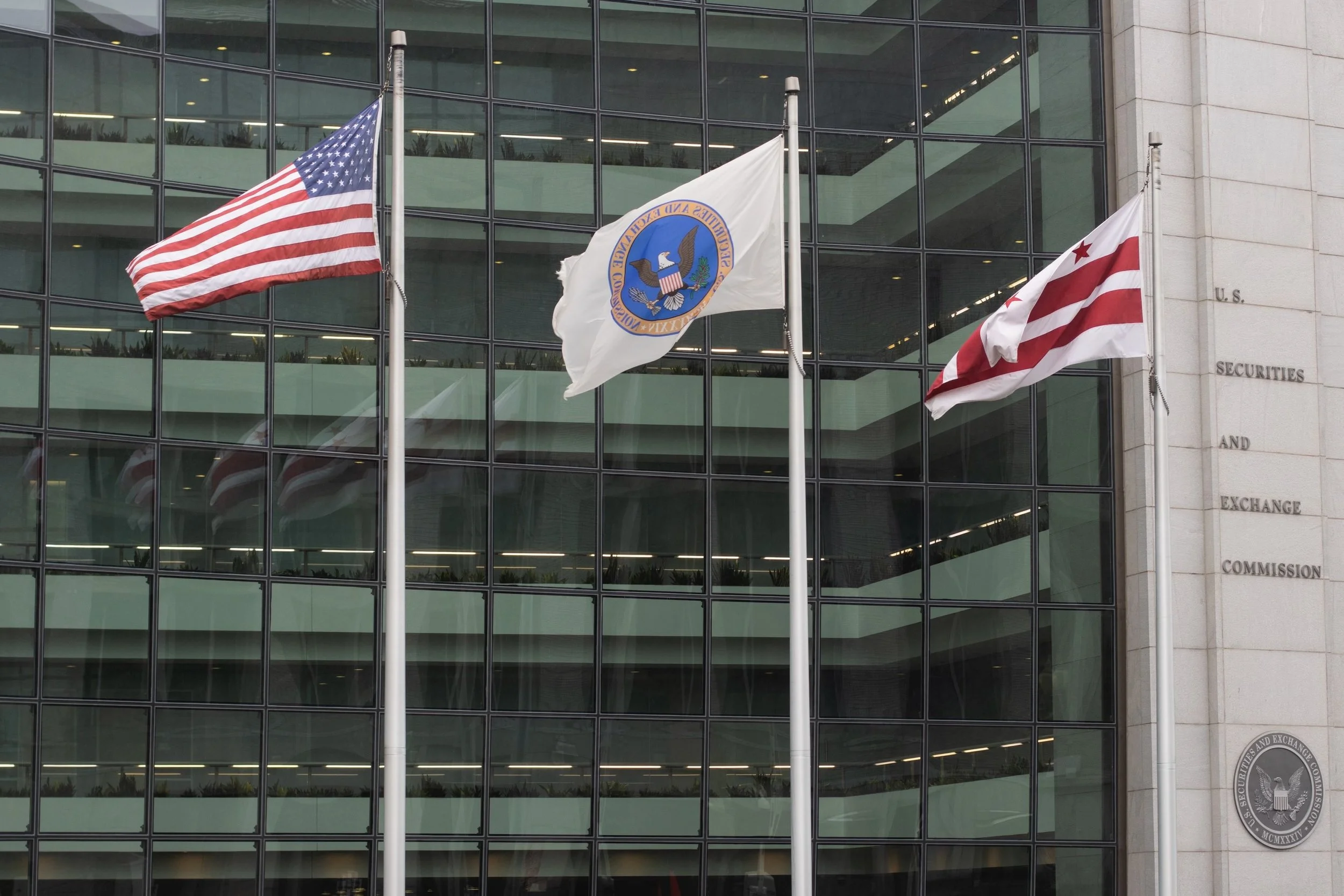
The year was defined by transition. Gary Gensler resigned as SEC Chair on January 20, 2025. Paul Atkins was sworn in as the new Chairman on April 21. Judge Margaret Ryan was named Director of Enforcement in September. In between, there was a 43-day government shutdown (the longest in history), a 15% reduction in SEC headcount, and a roughly 17% cut in Enforcement Division staffing. [1] [3] [4]
Here's a detail that tells you everything about the transition: of the 56 enforcement actions brought against public companies and their subsidiaries in FY 2025, 52 of them were filed under Gensler before he left. Only four were initiated under the new administration. That's the fewest in a single year since 2013. [1] [5]. In fact, 93% of all FY 2025 enforcement actions were brought before Gensler stepped down on January 20. [1]
Chairman Atkins has been explicit about the shift. In his congressional testimony, he said the SEC would focus on "cases of genuine harm and bad acts," not technical books-and-records violations or internal-controls issues. He's called for regulation through rulemaking rather than what the previous administration's critics called "regulation by enforcement." He publicly criticized the Gensler-era off-channel communications sweeps (which produced nine record-keeping cases in January 2025 alone) as having consumed excessive resources relative to investor harm. [1]
The SEC also dismissed a wave of high-profile cases on policy grounds: crypto enforcement actions against Coinbase, Binance, Gemini, Robinhood, and others. The SolarWinds cybersecurity case. FCPA actions following a Trump executive order pausing DOJ foreign bribery enforcement. The Atkins SEC brought zero new FCPA cases in FY 2025. [1] [3]
Refocusing on traditional rules
The enforcement slowdown was selective, not universal. And the areas where the SEC maintained or increased its focus are exactly the ones that matter most to broker-dealer firms.
Nearly one-third of all FY 2025 enforcement actions involved offering fraud or insider trading, up from 26% the prior year. Securities Offerings fraud cases alone comprised 27% of all actions, up from 22% in FY 2024. [1] [4]
Insider trading remained a core priority. The SEC charged a German national and a Singaporean national for their roles in an international insider trading ring that generated more than $17.5 million in illegal profits. A former director of a biopharmaceutical company, along with family members and friends, was charged with insider trading ahead of an acquisition, netting over $500,000 in illicit profits. A former head of equity trading at a Denver-based firm was charged with trading on confidential information across at least 10 public companies for 216,000$ illicit gains. In December, Three brothers were charged in a $41 million insider trading and stock manipulation scheme of two pharma company stocks. [1] [4] [6]
The SEC also went after major fraud schemes targeting retail investors: three former executives were sued over a $112 million Ponzi-like scheme involving REV brands like RadioShack and Pier 1 Imports. A Georgia-based firm and its founder were hit with an asset freeze in connection with an alleged $140 million Ponzi scheme that defrauded roughly 300 investors. [1]
The message from the new SEC leadership is clear: fewer cases, but the ones they bring will involve real money, real victims, and real consequences.
FINRA Turned Up the Heat
While the SEC was in transition, FINRA was anything but quiet. The 552 disciplinary actions in 2024 represented a sharp reversal from eight years of declining case numbers. And the top enforcement categories should make every broker-dealer compliance officer pay attention. [2]
The top five enforcement issues by total fines assessed in 2024 were: trade reporting, spoofing (for the first time), options trading violations, technological issues, and fingerprinting required non-registered persons. Spoofing, options trading violations, and technological issues all appeared in the top five for the first time. That's a significant shift. AML/BSA, which topped the list in prior years, remains a persistent area of regulatory focus. [2]
Total FINRA fines did decrease to $59 million (down 35% from $89 million in 2023), but that number is misleading in isolation. The increase in case volume combined with the types of violations being targeted tells you that FINRA is casting a wider net, not a looser one. [2]
Some specific cases from 2025 illustrate the point. FINRA ordered Securities America to pay $2 million in restitution to customers and fined the firm $1 million for mutual fund supervision failures. [7] First Trust Portfolios was fined $10 million for violations relating to gifts and entertainment. [8] Firms were fined $150,000 simply for not having surveillance procedures in place to monitor rates of deferred variable annuity exchanges. [9]
FINRA also elevated annuities to a standalone focus area in its 2025 Annual Regulatory Oversight Report, signaling that Reg BI enforcement around these products is only going to intensify. [9]
The Violations That Keep Costing Firms Millions (And What They Have in Common)
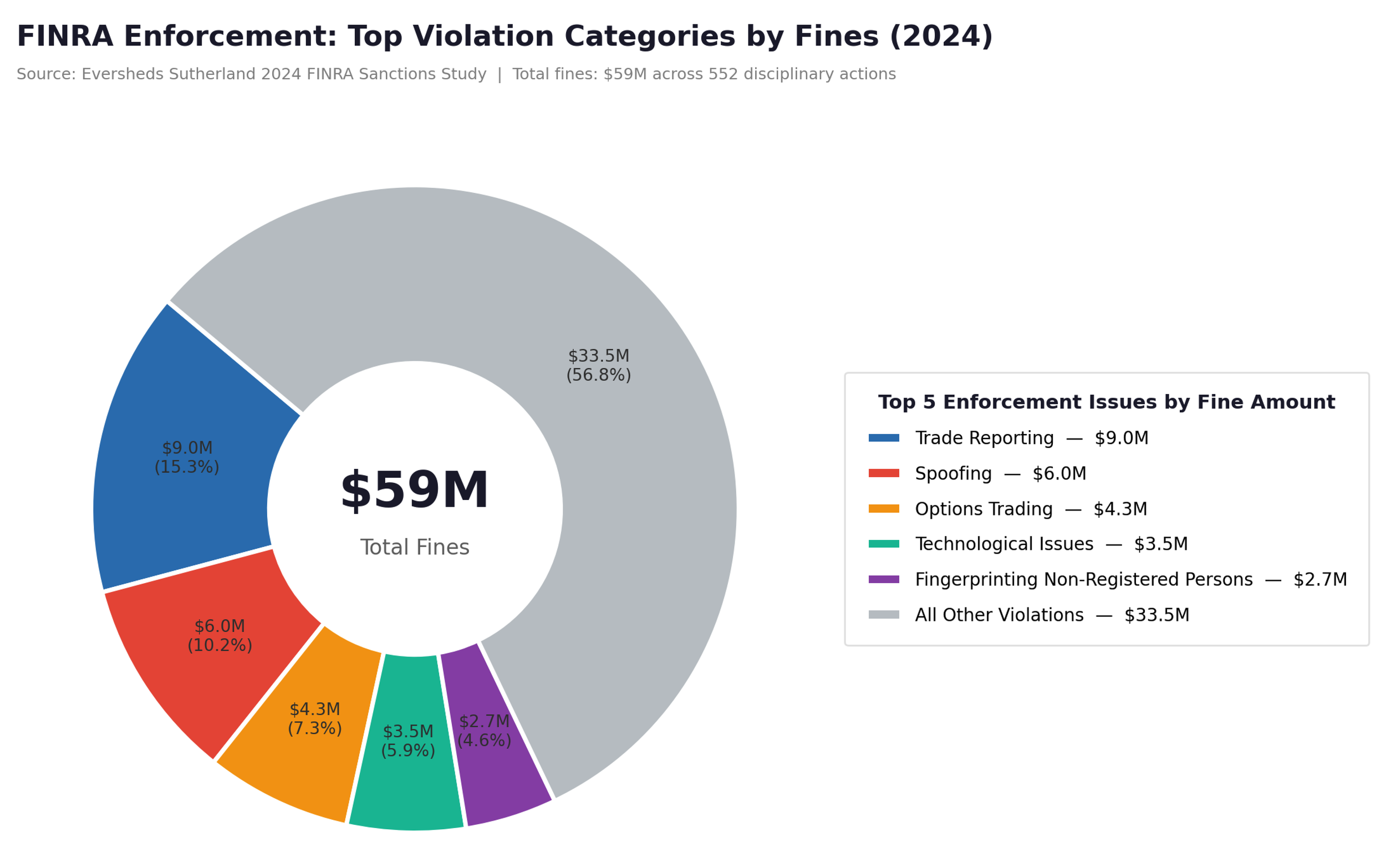
Looking at the violation categories driving the biggest fines and you'll notice a pattern. Nearly all of them come down to the same root problem: firms either didn't have surveillance systems in place, or the systems they had weren't designed to catch what regulators are now looking for. Especially the Trade Reporting Fines could have been avoided with tracking Low Priced Securities better.
Spoofing and layering. Now a top-five FINRA enforcement category for the first time. [2] Spoofing involves placing orders with the intent to cancel them before execution, creating a false impression of supply or demand. Layering is a variation where multiple orders are stacked at different price levels. Both are forms of market manipulation that regulators are actively hunting. Firms get fined not just because a trader engaged in the behavior, but because the firm had no surveillance in place to detect and flag it. A purpose-built spoofing and layering detection model identifies these patterns in real time by analyzing order-to-trade ratios, cancellation patterns, and price impact, before a pattern becomes a regulatory finding.
AML and low-priced securities. AML/BSA deficiencies have been a perennial top enforcement issue for FINRA, and a significant proportion of these violations at broker-dealers involve low-priced (penny stock) securities. [2] These names are magnets for manipulation: wash trading, layered orders, coordinated pump-and-dump activity, and suspicious volume spikes. Regulators expect firms to monitor for these patterns and to file Suspicious Activity Reports when they appear. A dedicated low-priced securities surveillance model is built to flag the exact red flags that trigger SAR obligations: unusual volume concentrations, price movements disconnected from news or fundamentals, and patterns of coordinated trading across accounts.
Insider trading and communications surveillance. The Gensler SEC's final enforcement push included nine off-channel communications cases in January 2025, [1] highlighting the need for firms to monitor communications tied to trading activity and detect patterns consistent with trading on material nonpublic information. The SEC's continued focus on insider trading, including cases involving encrypted messaging apps and coded language [6], only reinforces this.
Every one of these violation types is detectable with the right surveillance infrastructure. And the cost of not detecting them is orders of magnitude higher than the cost of the tools that catch them.
The Math That Should Keep CCOs Up at Night
Let's make this concrete. A mid-size broker-dealer facing a FINRA enforcement action is looking at anywhere from $500,000 to $3 million in fines and restitution at the lower end. Add legal fees for responding to an investigation that can stretch over months or years. Add the cost of remediation that FINRA will require. Add the reputational hit that affects recruiting, client retention, and business development. A $10 million fine like the one First Trust received [8] isn't just a financial event. It's a headline that follows the firm for years.
Now compare that to the annual cost of a surveillance platform that covers spoofing and layering detection, AML monitoring for low-priced securities, trade surveillance, and pattern recognition for manipulative trading. For most firms, the subscription cost is a small fraction of what a single enforcement action would cost. This isn't an abstract argument. When FINRA fines a firm $150,000 for not having surveillance procedures to monitor variable annuity exchange rates [9], the implicit message is: the technology to do this exists, it's accessible, and we expect you to use it. When the SEC charges individuals for insider trading schemes that ran for months or years without detection [1], the question every examiner will ask your firm is: what would your system have caught?
At Aerial View, this is exactly what we built our platform to solve. Our surveillance models cover the specific violation types that dominated 2025 enforcement: spoofing and layering detection, AML monitoring with dedicated low-priced securities models, and trade surveillance designed to flag the patterns that regulators are actively looking for. The platform generates audit-ready reporting so that when an examiner asks what your system caught, you have an answer that holds up.
We're not pitching a silver bullet. No surveillance system catches everything. But the gap between "we had no monitoring in place" and "our system flagged this pattern and here's the documentation" is the gap between a seven-figure fine and a clean exam.
What 2026 Looks Like
Several trends are converging that make the case for robust surveillance even stronger heading into 2026.
The SEC and FINRA are both increasing their use of data analytics and AI to detect violations, which means they're finding patterns faster and expecting firms to do the same. [10]
State regulators are stepping in to fill enforcement gaps as federal resources shrink. A lighter SEC doesn't mean lighter enforcement overall. It means enforcement is becoming more distributed and less predictable. [10]
Individual liability is increasing. The Atkins SEC has signaled that it wants to hold people accountable, not just firms. Corporate settlements may be rising, but so are charges against individuals, particularly in insider trading and fraud cases. [1] [10]
Social media disclosures are under heightened scrutiny. Companies and executives need to be aware that what they share online can trigger materiality questions and enforcement attention. [10]
And FINRA isn't slowing down. With annuities now a standalone focus area [9], Reg BI enforcement intensifying, and spoofing entering the top enforcement categories for the first time [2], the message to broker-dealers is unmistakable: your surveillance infrastructure needs to match the sophistication of what regulators are looking for.
2025 was a transition year, not a quiet year. The enforcement machine is leaner, more focused, and pointed directly at the kinds of violations that surveillance technology exists to catch. The question for every broker-dealer CCO heading into 2026 isn't whether enforcement is coming. It's whether you'll be ready when it does.
If you want to see how Aerial View's surveillance models work for your specific book of business, we'd welcome the conversation, book a demo right away.
References
[1] Fischman, H., Reisner, L., & Carey, J. (January 21, 2026). "SEC Enforcement: 2025 Year in Review." Paul Weiss, published on Harvard Law School Forum on Corporate Governance. https://corpgov.law.harvard.edu/2026/01/21/sec-enforcement-2025-year-in-review/
[2] Eversheds Sutherland Annual FINRA Sanctions Study (2024 data), reported by QuestCE. "FINRA Enforcement Patterns Emerge in 2024 Sanctions Study." https://www.questce.com/blog-finra-enforcement-patterns-emerge-in-2024-sanctions-study/
[3] Gibson Dunn. (February 4, 2026). "Securities Enforcement 2025 Year-End Update." https://www.gibsondunn.com/securities-enforcement-2025-year-end-update/
[4] White & Case. (January 29, 2026). "SEC FY 2025 Review: A Transformative Year in SEC Enforcement." https://www.whitecase.com/insight-alert/sec-fy-2025-review-transformative-year-sec-enforcement
[5] Cleary Gottlieb. (January 28, 2026). "The Shifting SEC Enforcement Landscape: 2025 Year-in-Review." https://www.clearymawatch.com/2026/01/the-shifting-sec-enforcement-landscape-2025-year-in-review/
[6] Secretariat. (February 12, 2026). "The Evolving SEC Enforcement Landscape: Trends for 2026." (Insider trading case details and enforcement methods.) https://secretariat-intl.com/insights/the-evolving-sec-enforcement-landscape-trends-for-2026/
[7] FINRA. (2025). "FINRA Orders Securities America to Pay $2 Million in Restitution to Customers, Fines Firm $1 Million for Mutual Fund Supervision Failures." https://www.finra.org/media-center/newsreleases/2025/finra-orders-securities-america-pay-2-million-restitution-customers
[8] FINRA. (2025). "FINRA Fines First Trust Portfolios $10 Million for Violations Relating to Gifts and Entertainment." https://www.finra.org/media-center/newsreleases/2025/first-trust-violations-fines
[9] InvestorCOM. (January 12, 2026). "FINRA's Annuity Fines: The Reg BI Signal Firms Can't Ignore." https://investorcom.com/finras-annuity-fines-the-reg-bi-signal-firms-cant-ignore/
[10] Secretariat. (February 12, 2026). "The Evolving SEC Enforcement Landscape: Trends for 2026." (Forward-looking 2026 trends and regulatory technology.) https://secretariat-intl.com/insights/the-evolving-sec-enforcement-landscape-trends-for-2026/